


By Emmanuel Daniji (BigDan)
For HiphopAfrica.net
The Wordsmith Hub (TWH) freestyle challenge—now one of the most influential proving grounds for lyricists in Nigeria—has become more than a competition. It is a market. A talent filter. A reputational stock exchange where credibility appreciates or crashes in real time. And at the center of its most disruptive narrative sits a rapper whose presence alone alters the odds.
Since the ₦1 Million prize format was introduced in November 2025, TWH has reshaped the incentives of freestyle culture. But it has also produced its first truly polarizing figure: a back-to-back winner whose dominance has triggered murmurs of “ban him” from competitors who believe the playing field tilts whenever he steps in.

That figure is Buez.
The Fear Factor: When Competition Becomes Psychological
In elite sport and high-stakes markets, fear is often the clearest indicator of dominance. It is no longer about who is best on paper, but who reshapes behavior simply by showing up.
Over the past weeks, HipHopAfrica.net learned that a number of freestyle rappers preparing for the new TWH season have privately expressed discomfort over the possibility of Buez participating again. The sentiment is not subtle: “If Buez enters, what’s the point?”
It is a rare admission in a culture built on bravado.
While December 2025 crowned El Rhey as winner, insiders quietly point to Buez’s absence that month as a key variable. In hip-hop terms, the data suggests a simple conclusion: when Buez competes, the ceiling changes.
Setting the Record Straight: The Buez Conversation
To separate myth from fact, HipHop journalist Emmanuel Daniji (BigDan) reached out directly to Buez amid claims that he had already “won ₦2 Million twice” and should therefore step aside.
His response was characteristically precise:

“I didn’t win the millions twice. With five editions so far, I’m the first rapper to win it back-to-back.
I won the ₦200k edition that got me on InstaBlog, then won the first ₦1 Million challenge in November.”
In competitive terms, this clarification matters. Dominance is not inflation; it is consistency under evolving rules.
When asked if he would still participate going forward, his answer was unequivocal:
“Yes, I will.”
And when told that some competitors were actively calling for his exclusion:
“Someone said they should ban me and it’s illegal for me to participate.”
(Laughs)
In hip-hop history, calls for bans rarely emerge from rule violations. They emerge when talent becomes inconvenient.
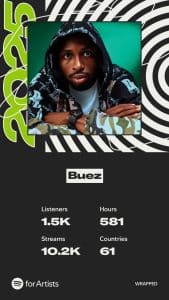
Performance by the Numbers: Buez’s 2025 Competitive Index
On December 31, Buez released a 2025 Wrap on X (formerly Twitter). It read less like bragging and more like a performance audit. Consider the metrics:
- No solo singles, but two high-impact features, including:
- “Tell Em Wait II” with Terry tha Rapman, Fozter & Spydermanne
- “Don’t Touch” with Tovia
- 10 Spaces rap battles, including bet battles and Money on the Floor formats — undefeated
- Delivered what many critics now call one of the coldest Round 3 performances in African battle rap history against Alpha Hybrid
- Daily rap output throughout November, pushing top-tier verses and indirectly raising peer performance across the scene
- Back-to-back Wordsmith Hub wins
- Winner of Abuja’s first-ever Compliment Battle
- Winner of TheScene’s inaugural rap battle competition
- Music integrated into the Web3 space
- Two official video shoots
This is not accidental success. It is a pattern of strategic visibility, competitive discipline, and cultural timing.
The Economics of Excellence: Why Buez Is “Unfair”
From a Forbes-style lens, the controversy around Buez is not about fairness—it is about market disruption.
Every competitive ecosystem eventually produces an outlier. Someone whose preparation, hunger, and adaptability exceed the average. When that happens, the system faces a choice:
- Raise the standard, or
- Remove the outlier.
Buez represents a rare hybrid in Nigerian hip-hop: a battle-ready lyricist who also understands timing, platforms, and momentum. He doesn’t just win; he compounds relevance. From InstaBlog virality to Web3 integration, his wins translate beyond applause into positioning.
That is why competitors are uneasy.
Should Buez Be Banned?
Short answer: No.
Long answer: banning a dominant artist for winning contradicts the very ethos of hip-hop. Battle culture was built on the idea that “the throne is open—come take it.” Excellence is not a violation.
If anything, Buez’s presence forces innovation. It exposes laziness. It punishes mediocrity. And it reminds the scene that talent alone is not enough—you must be relentless.
2026 Outlook: What Comes Next?
Buez has already hinted at a more music-focused 2026, promising increased releases and sharper execution. If his competitive instincts translate fully into recorded output, collaborations, and strategic distribution, he may be on the cusp of crossing from battle legend to mainstream disruptor.
Key areas to watch:
- Official single releases with broader rollout
- International or pan-African battle platforms
- Deeper Web3 music experimentation
- Curated projects that capture his battle intensity in studio form
Final Word
Buez is not a problem to be solved. He is a standard to be met.
In every generation, hip-hop produces artists who make excuses uncomfortable. In Nigeria’s current freestyle renaissance, Buez is that artist. Whether competitors rise to the challenge or continue whispering about bans will define the credibility of the culture itself.
One thing is certain: if Buez steps into The Wordsmith Hub again in 2026, the battle won’t just be lyrical.
It will be psychological.
What do you think? Should dominance be punished—or challenged? And what milestones would you like to see Buez conquer in 2026?